


Interactivity in the Media and Public Relations
- Oct 8, 2025
- 2 min read
Interactivity explores the relationship between technological properties, communication context and user perceptions. Furthermore, it encompasses both media and psychological factors. Interactivity also can be connected to how people use media to solve problems and share information, which incorporates the concept of communicative action in problem solving (CAPS).

Interactivity Defined
According to Kiousis's concept explication...
"Interactivity is the degree to which a communication technology can create a mediated environment in which participants can communicate (one-to-one, one-to-many, and many-to-many), both synchronously and asynchronously, and participate in reciprocal message exchanges" (Kiousis, 2002, p. 372).
Additionally, the psychological dimension states that interactivity encompasses human users and their ability to perceive an online experience. It’s about whether users feel like they’re really communicating with another person (interpersonal connection) and whether they feel “present” in a virtual space. Leary (1990) predicts that the success of an interactive medium hinges on its ability to resemble the interpersonal.
From a sociological perspective, DeFleur and Ball-Rokeach argue that "interactivity generally refers to the processes of communication that take on some of the characteristics of interpersonal communication" (DeFleur & Ball-Rokeach, 1989, p. 341).
This comprehensive approach allows researchers to study interactivity along its individual dimensions or as a single variable.
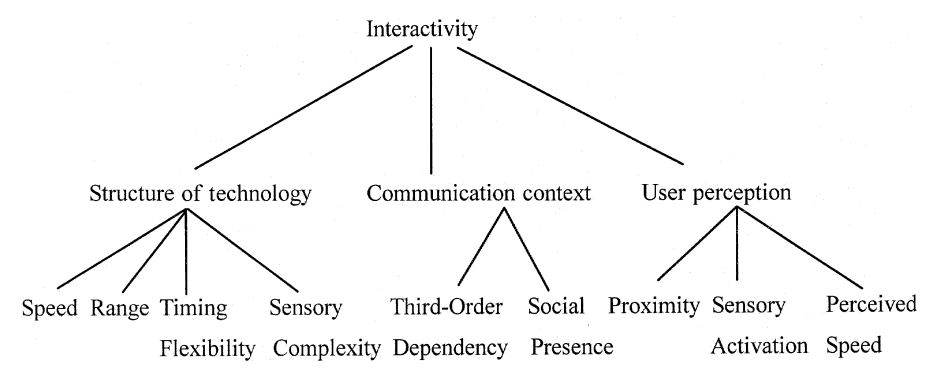
Interactivity alongside CAPS
While interactivity refers to the user's perception of communication in the media, communicative action in problem solving (CAPS) identifies the users-- or publics-- who are motivated to maximize their use of that medium's interactive capabilities. CAPS is defined by six variables relating to an individual's active or passive communication strategies (Kim, 2011).
How information is selected:
Information seeking (active)
Information attending (passive)
How information is acquired:
Information forefending (active)
Information permitting (passive)
How information is transmitted to others:
Information forwarding (active)
Information sharing (passive)
The behaviors of highly active publics (information seeking, information forefending and information forwarding) often occur within a mediated environment within communication technology through the concept of interactivity.
For example, when users seek out information or forward it to others, they’re actively engaging with media. On the other hand, when they simply attend to information or share it passively, they’re participating at a lower level of engagement. These behaviors depend heavily on how interactive a medium feels. The interactivity of a platform can lead to more opportunities for people to be active participants rather than passive observers.
Interactivity and CAPS work hand in hand to explain how people use technology to communicate and participate in digital spaces. Interactivity shapes how organizations build relationships with their publics through two-way communication, while CAPS helps explain how those publics choose to seek, share or respond to information. These concepts highlight how effective public relations relies on creating interactive experiences that encourage audiences to move from passive receivers to active participants in media communication efforts.
References
DeFleur, M.L. and Ball-Rokeach, S. J. (1989). In E.E. Anderson, G. (5th), Theories of Mass Communication, Longman Inc.
Kim, J.-N. (2011). Public segmentation using situational theory of problem solving: Illustrating summation method and testing segmented public profiles. PRism 8(2): http://www.prismjournal.org/home
Kiousis, S. (2002). Interactivity: a concept explication. New Media and Society, 4(3), 355-383. 10.1177/146144402320564392
Leary, T. (1990) ‘The Interpersonal, Interactive, Interdimensional Interface’, in B. Laurel (ed.) The Art of Human–Computer Interface Design, pp. 229–234. Menlo Park, CA: Addison-Wesley.


Comments